

When comparing hard pack vs soft pack cigarettes packaging, the biggest difference is the structure of the package. A hard pack typically uses a rigid paperboard box with a hinged or flip-top construction, while a soft pack uses a flexible paper-based wrapping system.
For cigarette and pre-roll packaging brands, choosing between these two formats affects protection, packaging cost, storage, transportation, printing, branding, and overall presentation.
As a custom packaging manufacturer, Well Paper Box helps brands develop customized paper packaging based on product dimensions, market requirements, artwork, materials, and production quantities.
A hard pack cigarette package is a relatively rigid paperboard box designed to maintain its shape during handling, transportation, storage, and retail display.
The traditional hard pack often features a flip-top structure, although custom packaging manufacturers can produce different box styles depending on the product and brand requirements.
Key Features of Hard Pack Cigarette Packaging
Hard packs commonly provide:
- · Rigid paperboard construction
- · Better resistance to crushing and deformation
- · A structured rectangular appearance
- · More stable retail presentation
- · Large printable surfaces
- · More options for premium finishing
- · Custom inserts or inner structures
Because the surface remains relatively flat and stable, hard packs are particularly suitable for brands that want to use custom printing, embossing, foil stamping, spot UV, or specialty paper.
Well Paper Box offers custom cigarette and pre-roll boxes in different sizes, shapes, materials, and finishing options, including CMYK/PMS printing, matte and gloss coatings, gold or silver foil, embossing, raised ink, and custom die cutting.
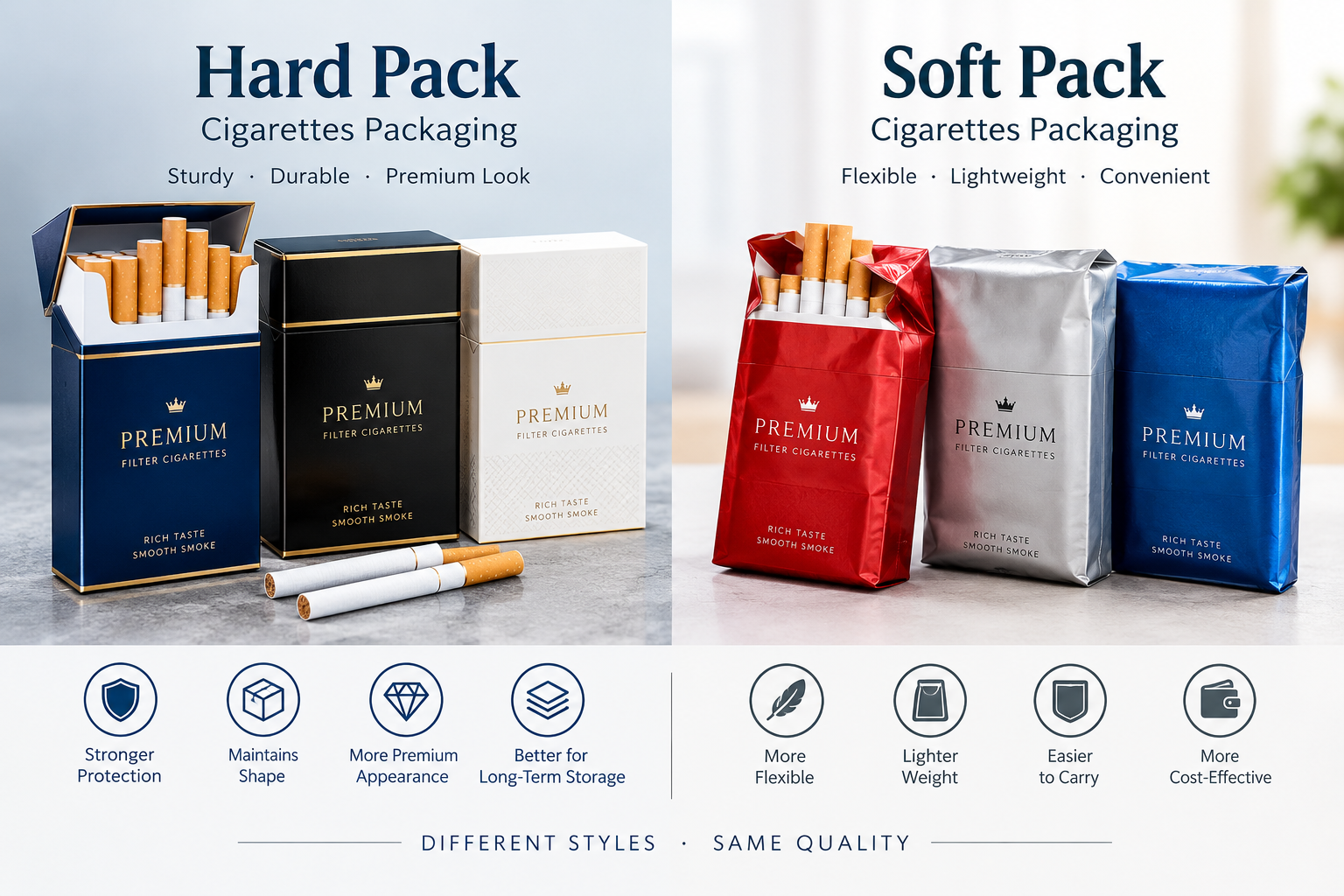
A soft pack cigarette package uses flexible packaging material instead of a rigid paperboard box.
The structure is generally lighter and more flexible than a hard pack. Because fewer rigid structural components are required, soft packaging can be attractive for brands prioritizing lightweight packaging and production efficiency.
Key Features of Soft Pack Packaging
Soft packs generally offer:
- · Flexible construction
- · Lower material consumption
- · Lightweight packaging
- · Easy handling
- · A traditional packaging appearance
- · Potentially lower packaging costs
However, soft packaging generally provides less structural protection against crushing compared with rigid hard packs.
For brands comparing packaging formats, the decision should therefore consider more than the initial unit price.
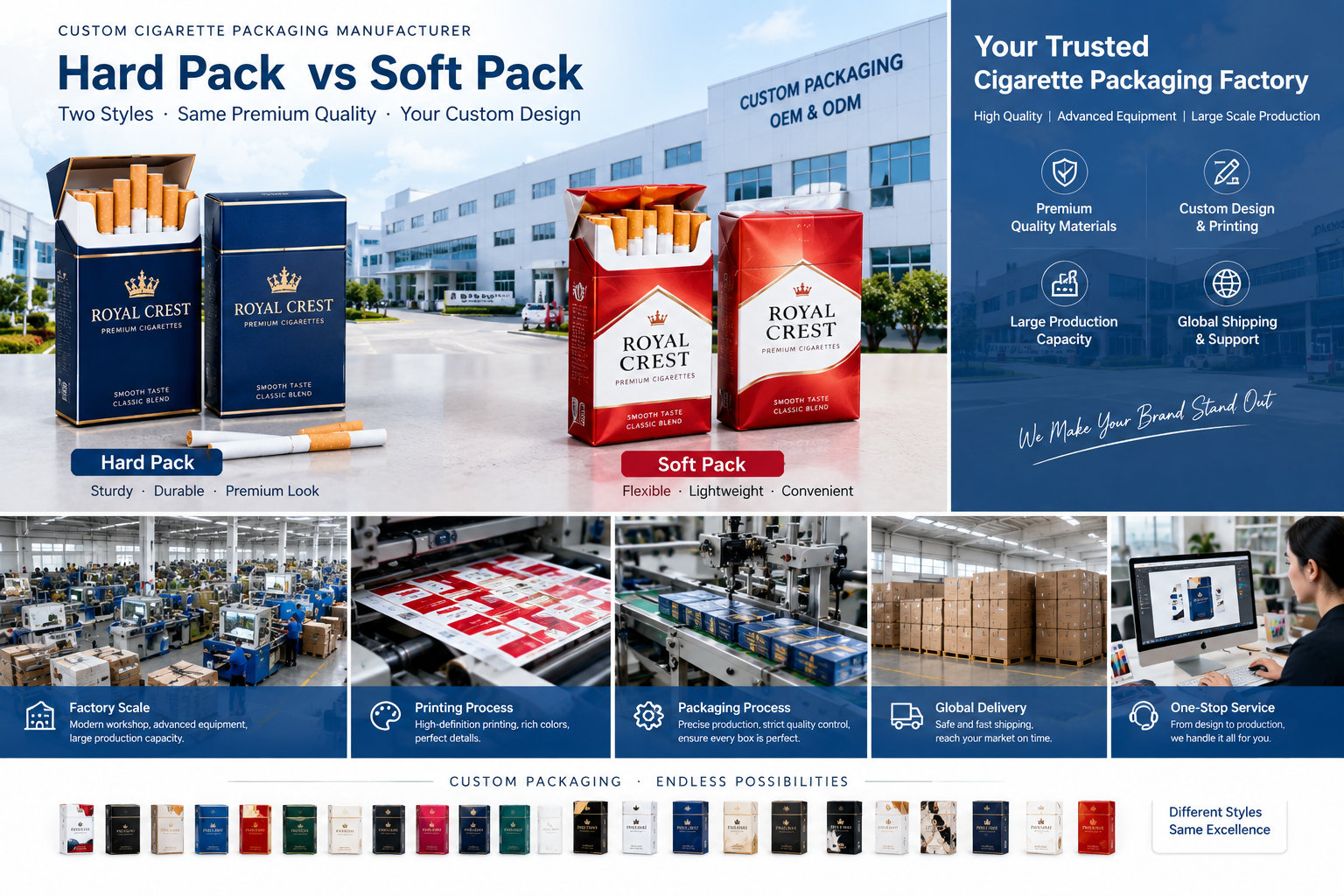
The following comparison summarizes the most important differences:
|
Feature |
Hard Pack |
Soft Pack |
| Structure | Rigid paperboard box | Flexible paper-based wrap |
| Shape retention | Excellent | Lower |
| Crush resistance | Higher | Lower |
| Packaging weight | Generally higher | Generally lower |
| Material usage | More structural material | Usually less |
| Printing surface | Stable and flat | More flexible |
| Premium finishing | Excellent | More limited |
| Retail presentation | Structured and consistent | Softer appearance |
| Storage | Easy to stack | More flexible |
| Custom box structures | Extensive | More limited |
| Typical cost | Usually higher | Often lower |
The exact cost difference depends on board specification, material consumption, printing, finishing, order quantity, structural complexity, and manufacturing requirements.
1. Protection and Durability
One of the strongest advantages of hard pack packaging is its rigid structure.
During shipping and storage, a rigid box can help maintain its shape and reduce deformation caused by external pressure. This is particularly useful when packaging needs to travel through multiple distribution stages.
Soft packs are more flexible and can be compressed more easily. For certain applications, this lightweight structure can be an advantage, but it may not provide the same level of physical protection.
2. Packaging Cost
Hard pack vs soft pack packaging cost is another major consideration.
Soft packs can use fewer structural materials and generally require a simpler flexible construction. Hard packs require paperboard, folding, cutting, scoring, gluing, and sometimes additional inner components.
However, packaging cost should not be evaluated only by material price.
The total cost may include:
- · Paperboard or paper material
- · Printing
- · Die cutting
- · Folding and gluing
- · Surface coating
- · Foil stamping
- · Embossing
- · Inner trays or inserts
- · Sampling
- · Packaging and shipping
- · Order quantity
For larger production runs, optimized dimensions and efficient material utilization can significantly affect the final unit price.
3. Printing and Brand Presentation
Hard packs provide a relatively stable surface, which gives designers more freedom when developing premium packaging.
For example, a custom hard pack can combine:
- · CMYK printing
- · PMS spot colors
- · Matte lamination
- · Gloss coating
- · Spot UV
- · Gold foil
- · Silver foil
- · Embossing
- · Raised ink
- · Custom windows
These techniques can help create different visual styles without changing the basic structural concept.
Well Paper Box provides custom cigarette and pre-roll packaging with multiple paper stocks, coatings, printing methods, and finishing options.
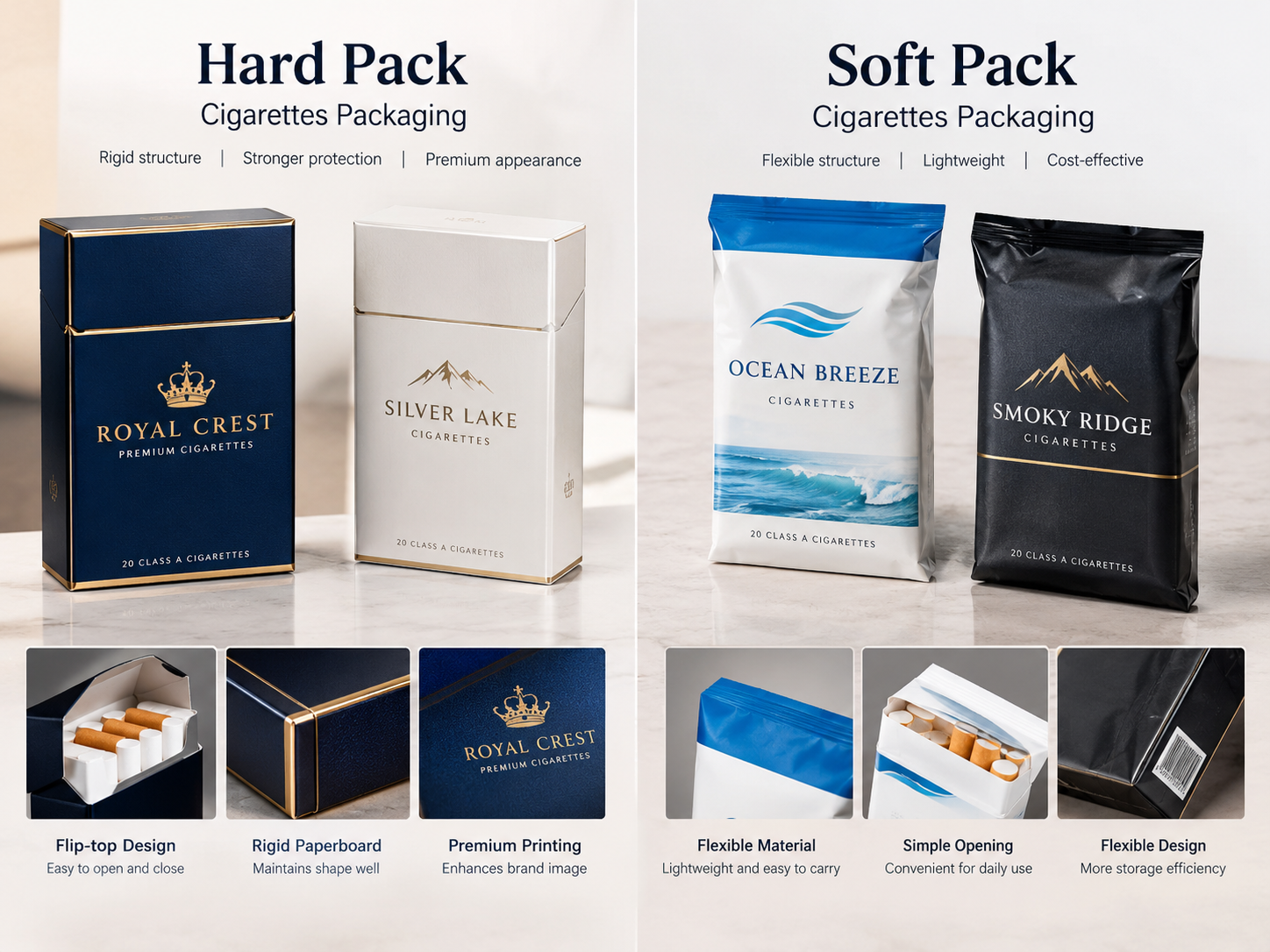
There is no universal answer.
A hard pack may be more suitable when your priority is:
- · Stronger structural protection
- · Premium presentation
- · Consistent shelf appearance
- · High-quality printing
- · Custom structural design
- · More advanced finishing
A soft pack may be more appropriate when your priority is:
- · Lightweight packaging
- · Flexible handling
- · Reduced material consumption
- · Simpler packaging structures
- · Potentially lower packaging costs
The right choice depends on the product, target market, distribution method, packaging regulations, and brand positioning.
For brands looking for custom pre-roll packaging, the same structural principles can be applied.
A rigid paperboard pre-roll box can be designed with internal compartments, trays, sleeves, or other structures to keep individual units organized.
Well Paper Box produces customized pre-roll packaging in multiple structures, including drawer-style and other custom paper box formats. Its product specifications support custom dimensions, printing, coatings, die cutting, scoring, gluing, and optional finishing processes.
For example, a pre-roll box can be developed with:
- · Multiple compartments
- · Custom inner trays
- · Pull-out drawer structures
- · Folding carton construction
- · Magnetic or premium rigid structures
- · Custom printed sleeves
- · Branded inserts
This allows brands to move beyond a standard cigarette pack and develop packaging that matches their product format.
Choosing a packaging manufacturer is just as important as selecting the packaging structure.
Before placing a production order, consider whether the manufacturer can provide:
1. Custom Structural Design
The manufacturer should be able to adjust dimensions, folding structures, compartments, inserts, and opening methods according to your product.
2. Material Selection
Different packaging applications require different board thicknesses, paper stocks, coatings, and structural specifications.
Well Paper Box offers materials such as coated paper, cardboard, kraft paper, specialty paper, and other customized packaging materials.
3. Professional Sampling
A physical sample can help verify:
- · Dimensions
- · Folding accuracy
- · Printing quality
- · Color
- · Structural strength
- · Finishing effects
- · Product fit
Sampling before mass production is particularly important for customized packaging.
4. Factory Production Capability
A reliable manufacturer should have the equipment and production capacity to support both standard and customized packaging orders.
Well Paper Box lists custom packaging quantities from approximately 1,000 to 500,000 pieces, with custom sizes, printing, coatings, die cutting, gluing, scoring, and other options.
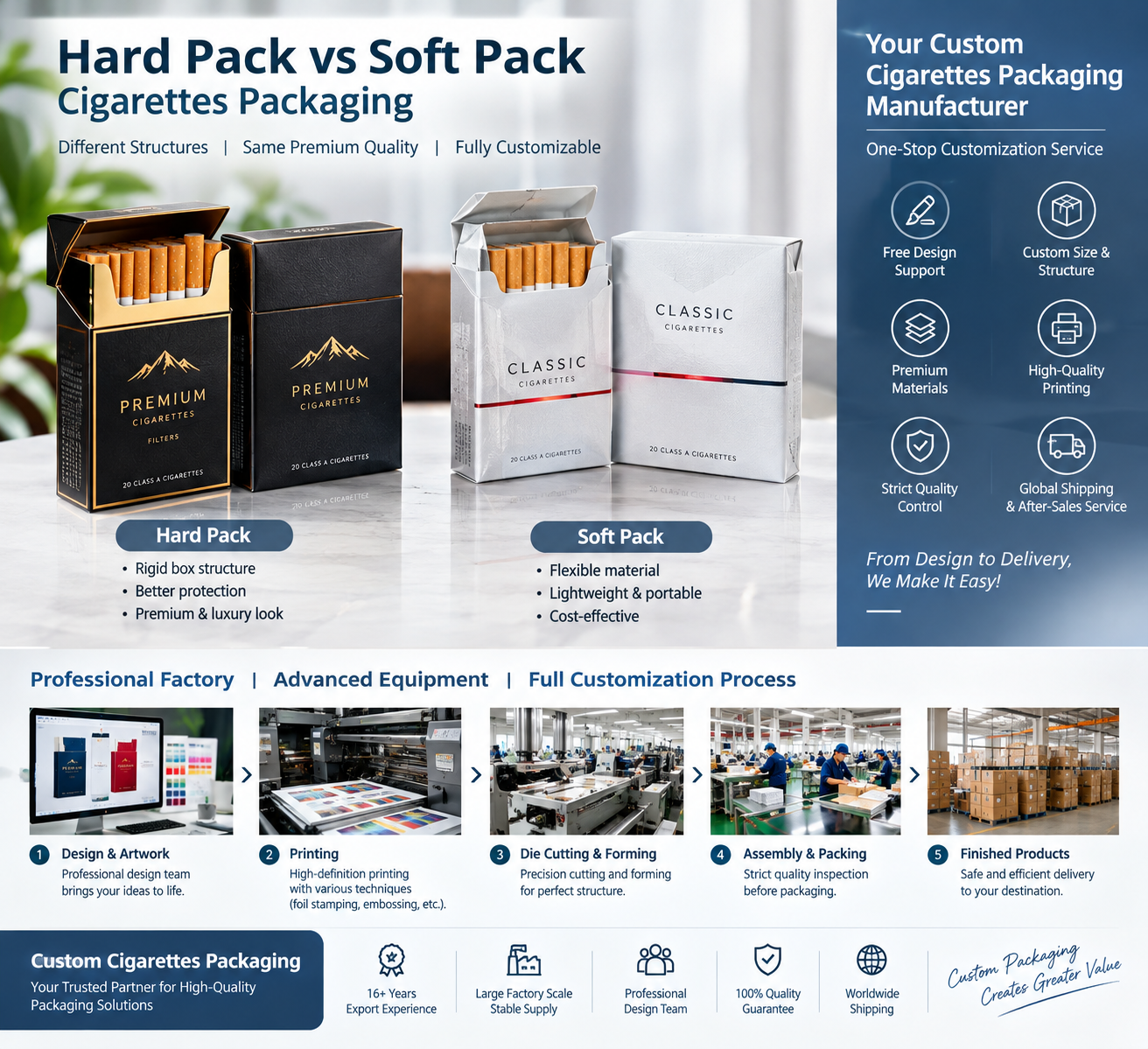
A typical custom packaging project can follow these steps:
Step 1: Confirm Product Specifications
Provide the product dimensions, quantity, number of units per pack, and preferred packaging format.
Step 2: Select the Structure
Decide whether a hard pack, soft pack, folding carton, drawer box, sleeve, or another structure is appropriate.
Step 3: Choose Materials
Select the appropriate paperboard or paper based on durability, appearance, printing requirements, and budget.
Step 4: Create the Artwork
Prepare the logo, colors, graphics, required information, and other packaging artwork.
Step 5: Produce a Sample
A physical prototype allows the structure and artwork to be checked before mass production.
Step 6: Begin Mass Production
After sample approval, the manufacturer proceeds with printing, die cutting, folding, gluing, finishing, inspection, and final packing.
For cigarette packaging, compliance is not optional. Requirements vary significantly by country and market.
For example, the U.S. FDA states that cigarette packages are subject to specific health-warning requirements, including requirements concerning warning placement and presentation. The regulatory status of particular warning rules can also change, so brands should verify the latest requirements for their target market before production.
For this reason, packaging artwork should be reviewed for regulatory requirements before printing, rather than after the boxes have entered production.
The difference between hard pack vs soft pack cigarettes packaging goes far beyond appearance.
Hard packs offer stronger structure, better shape retention, more stable printing surfaces, and greater flexibility for premium finishing. Soft packs offer a lighter and more flexible alternative that can potentially reduce material and packaging costs.
For brands developing customized cigarette or pre-roll packaging, the best solution depends on the product dimensions, target market, packaging budget, distribution requirements, and desired brand presentation.
If you need a custom packaging solution, Well Paper Box can support the process from structural design and material selection to sampling, printing, finishing, mass production, and quality control. Its custom packaging range includes cigarette boxes, pre-roll boxes, display boxes, drawer-style structures, and other paper packaging formats.
Generally, yes. The rigid paperboard structure of a hard pack provides better resistance to crushing and deformation than flexible soft packaging.
Soft packs can often have lower packaging costs because they use a simpler and more flexible structure. However, the actual price depends on materials, printing, order quantity, finishing, and production requirements.
Yes. Custom hard packs can be produced in different dimensions, structures, paper stocks, colors, printing methods, coatings, and finishing techniques.
Yes. Custom pre-roll packaging can use folding cartons, drawer boxes, sleeves, trays, compartments, and other structures depending on the product and applicable regulations.
You should normally provide product dimensions, quantity per package, order quantity, artwork requirements, preferred materials, target market, and any required packaging specifications.
Post time: Oct-09-2026